
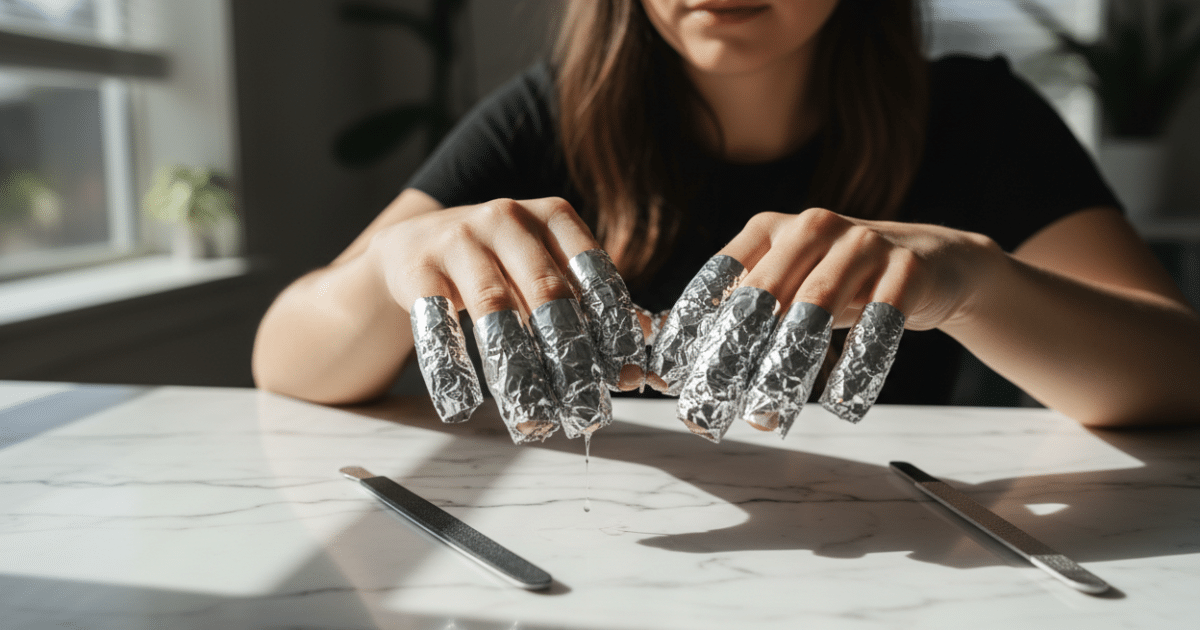
Dip powder nails are durable by design — which is exactly what makes them tricky to remove. The good news: you don't need a salon appointment to take them off cleanly. With the right technique and a little patience, you can remove dipped nails at home without wrecking your natural nails in the process.
You loved the finish, the longevity, the chip-free weeks. But now the grow-out is showing, and it's time to move on. Removing dip nails at home is entirely doable — and far less damaging than peeling or picking, which is the one mistake that will genuinely set your nails back. Here's how to do it properly.
Preparing your nails and tools before you start
Good removal starts before you open a single bottle. Rushing into the process without the right setup is how people end up with thin, peeling nails that take months to recover. Take five minutes to prepare, and the whole process becomes smoother.
What you'll need
The core supply list is short:
- 100% acetone (not regular nail polish remover — acetone-free formulas won't work on dip powder)
- A nail file, coarse grit (180 or lower)
- Aluminum foil cut into small squares, or reusable nail soaking clips
- Cotton balls or cotton pads
- A cuticle pusher or orange stick
- A nail buffer for finishing
- Cuticle oil or a rich hand cream
Pure acetone works significantly faster on dip powder than standard nail polish remover. If you only have the regular formula at hand, expect the process to take two to three times longer — and results will be inconsistent.
Filing down the top coat
Before acetone touches your nails, file off the shiny top coat. This step is non-negotiable. The top coat on dip nails acts as a sealant, and acetone cannot penetrate it efficiently without mechanical help first.
Use your coarse nail file and work in one direction across the entire nail surface. You're not trying to file down to the natural nail — just break through the glossy finish until the surface looks matte and slightly powdery. This typically takes 30 to 60 seconds per nail. Be careful around the edges and avoid pressing too hard near the cuticle area. Once every nail has a dull, matte appearance, you're ready to move to the actual removal.
The most effective methods to remove dipped nails at home
There are two main approaches that actually work: the foil wrap method and the bowl soak method. A third option — warm water with dish soap — works as a gentler alternative when acetone sensitivity is a concern, though it requires significantly more time.
The foil wrap method (recommended)
This is the gold standard for at-home dip nail removal. It concentrates the acetone directly on the nail, minimizes skin exposure, and gives you consistent results across all ten nails simultaneously.
Soak a cotton ball in pure acetone until it's saturated but not dripping. Place it directly on the nail surface and wrap the fingertip tightly with a square of aluminum foil. Repeat for every finger, then wait 15 to 20 minutes. Resist the urge to check every two minutes — the acetone needs sustained contact to break down the dip powder properly.
After the wait, remove one foil wrap and apply gentle pressure while sliding the cotton ball off the nail. Most of the product should come away with it. Use a cuticle pusher to gently nudge off any remaining residue, working from the cuticle toward the tip. Never scrape aggressively. If sections aren't lifting cleanly, re-wrap for another five to ten minutes rather than forcing it.
The bowl soak method
If you don't have foil on hand, a bowl soak works — but it exposes the surrounding skin to acetone for a longer period, which can cause dryness. To limit that, apply a thin layer of petroleum jelly or a thick hand cream around each nail before you start, keeping the product away from the nail plate itself.
Pour acetone into a small glass or ceramic bowl (avoid plastic — acetone can dissolve certain plastics). Submerge your fingertips and soak for 15 to 20 minutes. The dip powder will soften and begin to look almost spongy. Use a cuticle pusher to remove it gently, then buff lightly to smooth the surface.
Never soak your nails near an open flame. Acetone is highly flammable. Work in a well-ventilated room, away from candles, stovetops, or any heat source.
The warm water and dish soap method
For those with sensitive skin or a low tolerance for acetone fumes, warm water with a few drops of dish soap offers a slower but gentler alternative. After filing off the top coat, soak nails in warm (not hot) soapy water for 20 to 30 minutes. The powder will soften enough to be nudged off with an orange stick, though you may need to repeat the process once or twice for full removal. This method works best on dip manicures that are already lifting at the edges.
Post-removal nail care to restore and protect
Once the dip powder is off, your natural nails deserve some attention. Dip products adhere directly to the nail plate, and even a careful removal process leaves nails slightly dehydrated and more fragile than usual. Skipping the aftercare step is a mistake — this is where the real protection happens.
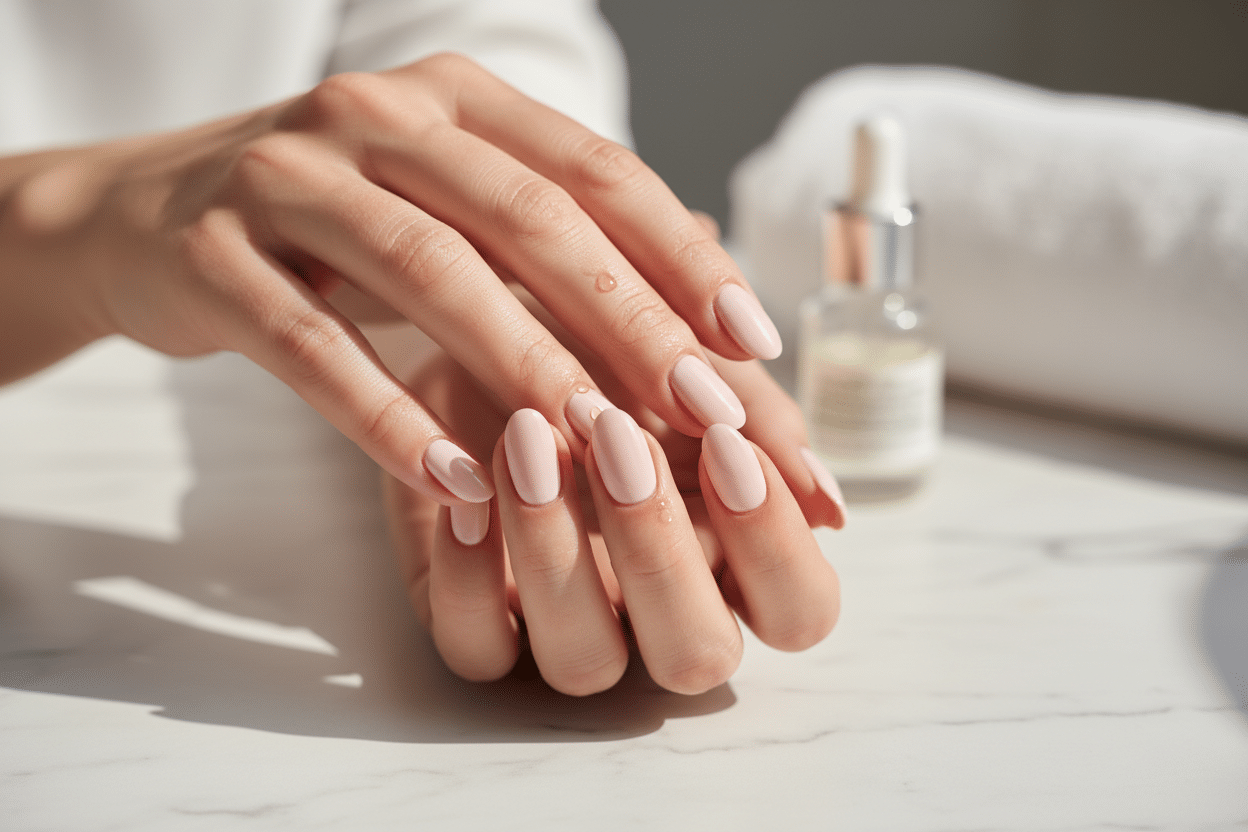
Buffing and rehydrating immediately after removal
After removing all the product, buff each nail lightly with a fine-grit buffer to smooth out any uneven texture. Don't over-buff — two or three passes per nail is enough. The goal is a smooth surface, not a thinner nail.
Then, apply cuticle oil generously to each nail and the surrounding skin. Massage it in for a minute or two. Cuticle oil penetrates the nail plate and begins restoring flexibility almost immediately. If you have a nail strengthener or a keratin-based treatment, this is the right moment to apply a coat. Follow with a rich hand cream and let everything absorb before doing anything else.
Protecting nails in the days following removal
In the first week after removal, treat your nails gently. Avoid harsh cleaning products without gloves, skip the nail polish if possible (or use a breathable formula), and apply cuticle oil at least once a day. Nails that feel thin or peel slightly after dip removal are normal — they need hydration and time, not another heavy product layered on top.
If you're planning your next manicure soon, wait at least three to five days before applying any new product. This gives the nail plate time to rehydrate and reduces the risk of lifting or poor adhesion with your next application.
Cuticle oil applied immediately after removal is the single most effective step for nail recovery. Don’t skip it — it makes a visible difference within days.
Common mistakes that damage nails during dip powder removal
Most nail damage from dip removal isn't caused by the products — it's caused by impatience and shortcuts. These are the errors that show up consistently, and they're all avoidable.
Peeling or picking the product off
This is by far the most damaging thing you can do. Dip powder bonds to the nail plate, so peeling it off doesn't just remove the product — it removes layers of the actual nail with it. The result is thin, white, peeling nails that take three to six months to fully grow out. If the product isn't lifting after soaking, the answer is always more time with acetone, never more force.
Skipping the filing step
Applying acetone directly to an unfiled nail is a waste of time. The top coat is designed to resist moisture and solvents — that's what gives dip nails their durability. Without filing, you can soak for 30 minutes and see almost no result. File first, every time.
Using acetone-free nail polish remover
Standard nail polish remover is formulated for regular lacquer. It will not break down dip powder effectively. Some people soak for an hour with acetone-free remover and wonder why the product won't budge. Pure acetone is the correct tool for this job — there's no equivalent substitute when it comes to dip nail removal.
Over-filing into the natural nail
The filing step is meant to break the top coat, not thin the nail. Pressing too hard or filing in circles rather than one direction generates heat and removes more than necessary. Keep pressure light, use a back-and-forth motion in one direction, and stop as soon as the surface turns matte. The acetone handles the rest.
- Filing off the top coat before soaking
- Using pure 100% acetone
- Waiting the full 15–20 minutes before removing foil
- Applying cuticle oil immediately after
- Gently nudging residue with an orange stick
- Peeling or forcing the product off
- Using acetone-free remover
- Skipping the filing step
- Over-filing into the nail plate
- Ignoring aftercare and rehydration
Removing dip powder nails at home is a straightforward process when you follow the right sequence — file, soak, remove gently, hydrate. The nails that come out damaged are almost always the result of one of the mistakes above, not the process itself. Do it properly once, and you'll never feel the need to rush to a salon just for a removal appointment again.